

Indoor Plant LED Grow Light is an artificial light source that uses LED (light-emitting diode) technology to simulate the wavelengths (mainly red and blue) required for plant photosynthesis in the solar spectrum. Its core principle is to provide the best growth environment for plants by precisely controlling light quality, light intensity and lighting time, especially replacing natural light in indoor places with insufficient light or in rainy weather.
1. Type and spectrum configuration
According to spectrum type:
Red and blue light combination lamp: mainly 660nm red light (promotes flowering and fruiting) and 450nm blue light (promotes leaf growth), presenting pink light, suitable for full-cycle growth.
Full spectrum lamp: simulates sunlight, including red, blue, green and white light, closer to natural light, suitable for ornamental plants or crops that require a balanced spectrum.
Adjustable spectrum lamp: dynamically adjusts the red and blue light ratio through an intelligent control system to meet the needs of plants at different growth stages (such as high blue light in the seedling stage and high red light in the flowering stage).
By power and form:
Low-power lamps (1-50W): suitable for small potted plants, seedling racks or desktop planting.
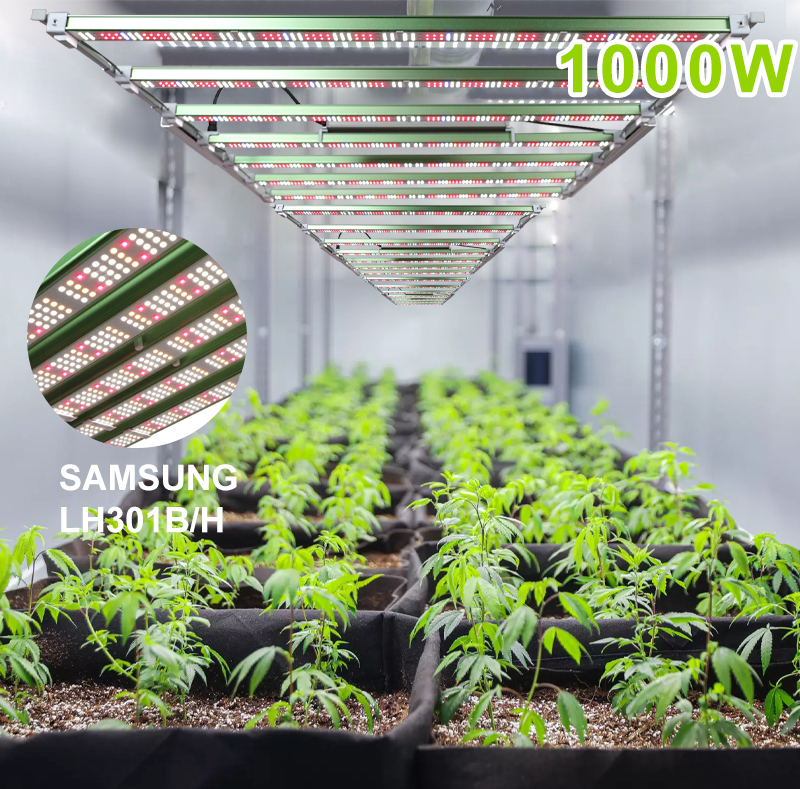
Medium-high power lamps (100-1000W): used for commercial planting, vertical farms or multi-layer cultivation systems.
Tube type, panel type, bulb type: flexibly adapt to different planting scenarios, such as hanging panel lights suitable for large-area supplementary lighting, and tube type suitable for layered planting.
2. Core features and technical advantages
Efficient energy saving:
LED luminous efficiency is 10 times that of traditional incandescent lamps, and energy consumption is reduced by more than 80%. For example, a 100W LED lamp can replace a 1000W metal halide lamp, saving more than 1,000 yuan in electricity bills per year (calculated based on commercial planting scale).
Passive heat dissipation design (such as aluminum fins) reduces energy loss and extends the life of lamps to more than 50,000 hours.
Precise and controllable spectrum:
Directed output of plant-sensitive bands (such as 660nm red light, 450nm blue light) can avoid invalid spectrum waste and increase light energy utilization by 30%.
Experiments show that the red and blue light combination lamp shortens the growth cycle of lettuce by 20% and increases the vitamin C content by 15%.
Low heat load and space optimization:
The heat generated by LED is only 20% of that of high-pressure sodium lamps, reducing the risk of plant burns and reducing the cost of greenhouse cooling.
The compact design supports multi-layer cultivation (such as 4-layer three-dimensional planting racks), and the yield per unit area is increased by 3-4 times.
Environmental protection and safety:
No harmful substances such as mercury and lead, and the cost of waste disposal is low.
Low voltage operation (usually below 24V) avoids fire hazards and is suitable for home use.
3. Application scenarios
Commercial planting:
Greenhouse supplementary lighting: In areas with insufficient light such as Northern Europe, LED lights increase the annual yield of tomatoes from 15kg/m² to 25kg/m².
Vertical farms: For example, Singapore Sky Greens Farm uses LED layered planting, shortening the hydroponic lettuce cycle to 28 days, and the annual yield is 10 times that of conventional planting.
Home gardening:
Balcony planting: Low-power LED lamps (such as 20W) can meet the needs of small crops such as vanilla and strawberries, and achieve "balcony self-sufficiency".
Indoor decoration: Full-spectrum LED lamps have both lighting and plant growth functions, improving the beauty of the home.
Scientific research and special planting:
Plant tissue culture: High-precision spectrum control promotes cell division and improves the survival rate of test tube seedlings.
Aerospace agriculture: NASA uses LED lamps to grow lettuce on the International Space Station, verifying its feasibility in a closed environment.
4. Usage and precautions
Light parameter settings:
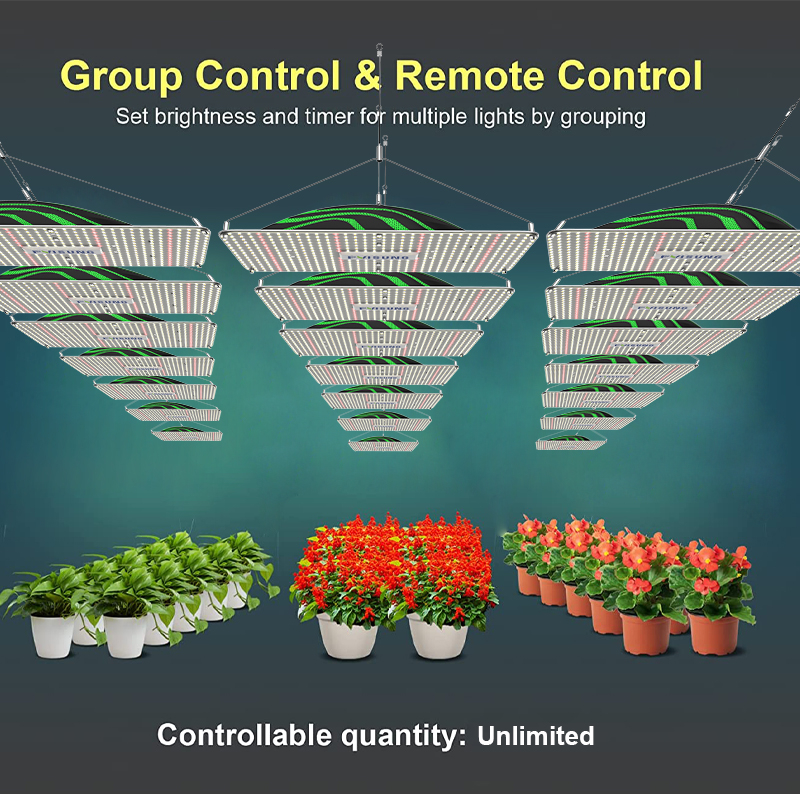
Photoperiod: Most plants require 14-16 hours of light/8 hours of darkness, which can be automatically controlled by a timer.
Light intensity: PPFD (photosynthetic photon flux density) is recommended to be 200-400μmol/m²/s during the seedling period, and increased to 600-800μmol/m²/s during the flowering period.
Suspension height: Low-power lamps are 20-30cm away from the plants, and high-power lamps are kept at 50-100cm to avoid heat accumulation.
Environmental collaborative management:
Temperature and humidity: The temperature under LED lights should be controlled at 20-28℃, and the humidity should be 50%-70% to prevent excessive transpiration.
CO₂ supplementation: Increasing CO₂ (to 1000-1500ppm) in a high-light environment can further improve photosynthetic efficiency.
5. Suitable plants and effect cases
Leafy vegetables (lettuce, spinach):
LED supplementary lighting increases the dry matter accumulation of lettuce by 25%, and reduces the nitrate content by 40%, which meets the standards for organic vegetables.
Fruits and vegetables (tomatoes, strawberries):
When the ratio of red to blue light is 6:1, the fruit setting rate of tomatoes increases by 35%, and the weight of single fruit increases by 12%.
Strawberries can achieve continuous fruiting throughout the year under LED lights, and the yield per mu is 3 times that of conventional planting.
Flowers (roses, orchids):
Blue light promotes rose branching, red light prolongs the flowering period, and the cut flower yield increases by 50%.
The flowering period of orchids under LED lights is shortened to 6 months (12-18 months under natural conditions).
Medicinal plants (Anoectochilus roxburghii, Dendrobium candidum):
LED’s precise spectrum increases the content of flavonoids in Anoectochilus roxburghii by 18%, significantly enhancing its medicinal value.