

1. LED Grow Light Structure
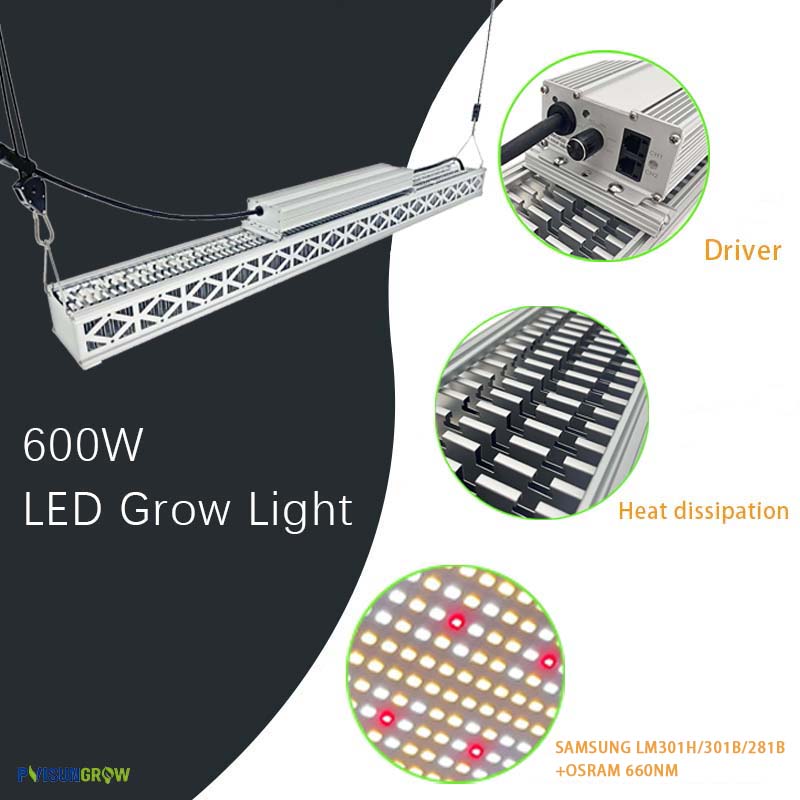
The core structure of an LED grow light includes the LED chip, cooling system, power supply, optical lens, and housing:
LED chip: Utilizes high-power or surface-mount (SMD) technology, mimicking the natural light spectrum by combining red, blue, and white light. Some models integrate a full-spectrum chip to cover the needs of plants throughout their life cycle.
Cooling System: Primarily uses aluminum heat sinks or heat pipes. Some high-end models utilize liquid cooling or graphene cooling to ensure stable chip temperature (typically controlled at 40-60°C) even under long-term, high-intensity operation.
Power Supply: A constant-current drive circuit design supports a wide input voltage range (e.g., AC100-240V) and features overvoltage and overcurrent protection to ensure light source stability.
Optical Lens: Secondary optical designs (such as convex lenses and Fresnel lenses) focus light and improve light utilization. Some models feature adjustable lens angles to accommodate different growing scenarios. Housing: Aluminum-plastic composite structure or high-strength plastic, balancing protection and lightweight. Some models feature IP65 waterproof and dustproof ratings.
2. Material Features
Efficient and Energy-Saving: Utilizing high-efficiency LED chips (luminous efficacy reaching 2.5-3.0 μmol/J), these lamps save 50%-70% energy compared to traditional HID lamps (such as high-pressure sodium lamps) and offer 3-5 times the brightness at the same power.
Long Life: The LED chip lifespan reaches 50,000-100,000 hours, 5-10 times that of traditional light sources, reducing replacement frequency and maintenance costs.
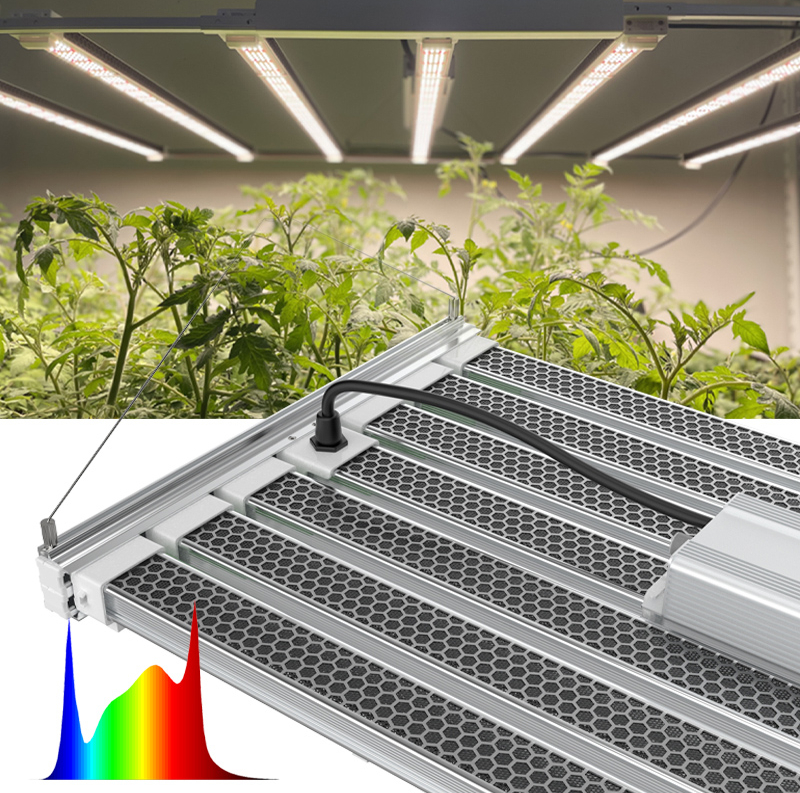
Adjustable Spectrum: By adjusting the ratio of red, blue, and white light (e.g., red light 600-700nm, blue light 400-500nm), the lamp precisely matches the needs of different plant growth stages (e.g., blue light for the vegetative stage and red light for the flowering stage).
Low Heat Output: Utilizing DC drive technology, heat is concentrated in the heat dissipation system rather than the lamp body, allowing for close illumination of plants (typically 15-30cm) to avoid burns. Environmentally friendly and safe: Free of mercury, lead, and other hazardous substances, LEDs offer low electromagnetic radiation and are RoHS compliant, making them suitable for both home and commercial grows.
3. Lighting Principle
LED grow lights simulate sunlight through the principle of electroluminescence:
Semiconductor recombination: When current passes through a P-type (hole) and an N-type (electron) semiconductor, the electrons and holes recombine, releasing energy in the form of photons (wavelength determined by the material's band gap).
Spectral Matching: Plant chlorophyll absorbs red light (640-660nm) and blue light (430-450nm) most efficiently. By precisely controlling the wavelength ratio, LEDs directly provide the light energy required for photosynthesis, reducing waste of inefficient light.
Photoperiod Control: A timer controls the duration of light exposure (e.g., 16 hours of light/8 hours of dark) to simulate natural circadian rhythms and promote plant growth and flowering.
4. Power Type and Function
Low-power (10-50W): Suitable for small home grows (such as herbs and succulents), covering an area of 0.5-1㎡, and can replace desktop lamps. Medium-power models (100-300W): Cover an area of 2-5 square meters, suitable for supplemental lighting in medium-sized grow boxes or greenhouses, supporting the full growth cycle of vegetables and flowers.
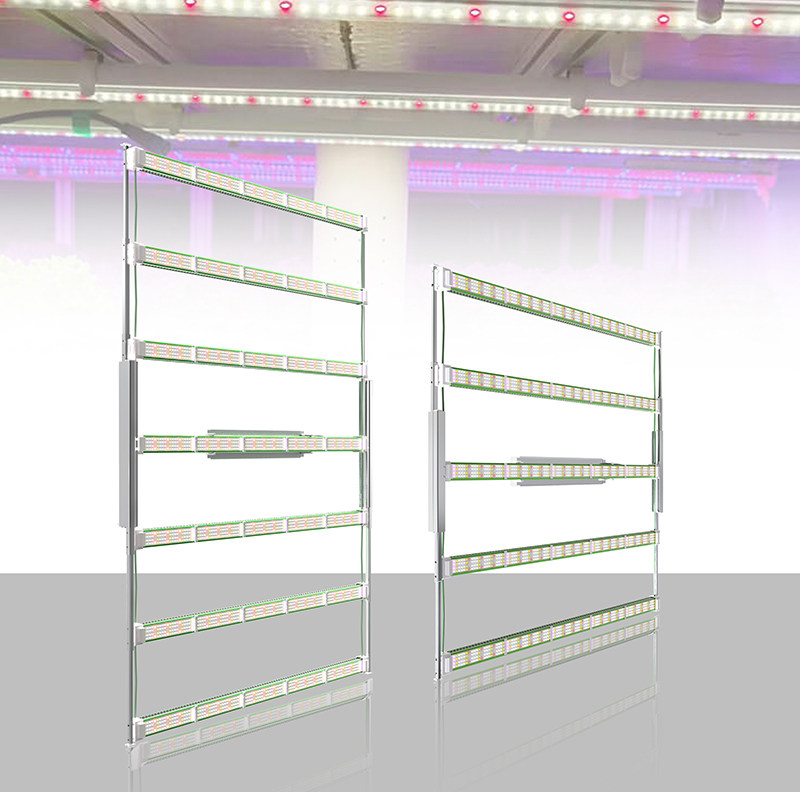
High-power models (500W and above): Cover an area of 10 square meters or more, used for commercial cultivation (such as vertical tomato and strawberry farms), supporting high-density planting and off-season production.
Functions:
Promote photosynthesis: Improve chlorophyll synthesis efficiency and accelerate plant growth.
Regulate morphology: Control plant height, leaf thickness, and branch number by adjusting the red/blue light ratio.
Induce flowering and fruiting: Specific wavelengths of red light can stimulate the secretion of flowering hormones (such as gibberellins) in plants, increasing yield.
Supplement insufficient light: Extend the daylight duration on rainy days or in winter to maintain plant growth.
5. Selection Guide
Spectrum Requirements:
For full-cycle cultivation: Choose a full-spectrum LED light (covering 380-760nm) to support the entire growth cycle from seedling to flowering. Specific Stages: Choose a high blue light ratio (e.g., B:R = 3:1) during the vegetative growth phase, and a high red light ratio (e.g., B:R = 1:3) during the flowering phase.
Light Intensity (PPFD):
Seedling Stage: 100-300 μmol/m²/s
Vegetative Stage: 300-600 μmol/m²/s
Flowering and Fruiting Stage: 600-1000 μmol/m²/s
(This needs to be adjusted based on the planting distance; generally, the PPFD decreases by 50% for every 30 cm increase in height.)
Coverage Area:
Calculation: Power (W) × Luminous Efficacy (μmol/J) ÷ Target PPFD Value
Example: A 300W lamp (2.5 μmol/J) needs to achieve 600 μmol/m²/s. Coverage Area = 300 × 2.5 ÷ 600 = 1.25 m2.
Heat Dissipation and Lifespan:
Select an aluminum heat sink with a fan or a fanless passive cooling design to ensure the lamp body temperature is ≤ 60°C. Prioritize models with a lifespan of 50,000 hours or more to reduce replacement costs.
Additional Features:
Smart Dimming: Adjust light intensity and spectrum via the app or remote control.
Timer: Automatically simulates circadian rhythms.
Waterproof Rating: IP65 or higher is required for greenhouse or humid environments.